Back in the days of whaling, a whaling crew would follow a
captain’s orders even if it ended up being to their detriment, as in the story
of Moby Dick. The story of Captain
Ahab chasing the white whale to the point of his and his crew’s destruction is
well-known. Only Ishmael, an insignificant crew member, survived to tell the
tale. Perhaps it was dumb luck that Ishmael survived the encounter with Moby
Dick, but his telling of the tale is amazing because of all of the curation of
research he does after his survival, and all of the mental notes he makes on
crew members. Ishmael did not have a one-track mind, unlike Captain Ahab. And
just like Ishmael, we need to be willing to look at all angles of literary
study and abandon the angles that do not work (even if they used to be the best
angles). The angle that is most important to look at right now is the digital
and how it can enhance the study of literature today.
Showing posts with label Moby Dick. Show all posts
Showing posts with label Moby Dick. Show all posts
Wednesday, December 18, 2013
Let's Be Ishmaels

Tuesday, November 12, 2013
What's in a name? An Exploration of the Names of the Six Main Characters of Moby Dick
I love that line in Shakespeare's Romeo and Juliet ("What's in a name? That which we call a rose by any other name would smell as sweet?" Act II Scene II Lines 46-47).
I decided to put Shakespeare's words to the test and look at the names of the six main characters in Moby Dick. I wanted to see if there was any extra significance to their names, or if they really were just names. I decided to look up the origins of the names, their meanings, and then the text surrounding their names in Moby Dick.
Origins
I used Google Translate to look up the origins of their names. Here is what I found:
Ahab: German
Queequeg: no response, but Spanish was guessed before I finished typing the name.
Ishmael: no response, but English and Albanian were guessed.
Stubb: Finnish
Starbuck: no response, but Italian, English, German, Lithuanian were guessed.
Flask: no response, but Portuguese and Albanian were guessed.
Then, just for kicks, I decided to see if their names would translate to a language completley different from English. Here are their names in Japanese:
Ahab: アハブ
Queequeg: would not translate
Ishmael: イシマエル
Stubb: would not translate
Starbuck: スターバック
Flask: フラスコ
The names translated back to English from Japanese name perfectly each time. When I translated the Japanese name to another language like Russian or Alabanian and then back to English, it sometimes went back to the way the name was in English (like for Ishmael), but a different translation (such as Flask to bulb).
Continued Research into Origins and Meanings
I decided to do some more research into the origin/meaning of the names and came across the site Behindthename.com. I stuck each name into the search bar and below are the screen shots of what appeared.


The only names Behindthename.com was able to find anything for was Ahab and Ishmael (both Hebrew names that English speakers name their children). Both names are biblical, which may explain why there is so much Biblical language in the book (it fits the two main characters). Starbuck had a popular culture reference, but nothing to do with Moby Dick.
In the Text
I decided to look at the text itself to see if there were any words that were commonly linked with each of these six characters. The words listed below are both those used to describe the characters, phrases near the names that I found interesting, or words that often appeared near the name at multiple points in the text.
Ahab: precise agency, inscrutable, leaped after his prey, Captain, peculiar fortunes, side-lunging strides, commanded, a queer man, grand, godly, ungodlike, above the common, a crowned king, a wicked name, King, "I am a cannon-ball."
Queequeg: Ramadan, entertaining, absurd notions, content, knew, harpoon, pagan, cannibal, tomahawk, savages, creature, civilized, alone, heathen, Christian, affectionate, ambitious, embrace, kill-e, Yojo.
"A native of Rokovoko, an island far away to the West and South. it is not down in any map; true places never are."
Ishmael: Call me, one, dear, don't be too particular, said I, muttered I, thine, thought I, I, thy, unlettered. Talks to himself a lot. Lots of bibilical language--he is the narrator.
Stubb: luck, aye, easy, pipe, mate, humorous, speechless a moment, involuntarily retreated, old man, wise, laugh, odd, peculiar, Mr., drawled, counted upon, cheered, cried, supper, Starbuck, Flask, Ahab
Starbuck: lively, friend, chief mate, courage, fortitude, Mr., murmured, paled, right-mindedness, coerced will, cooly and adroitly balancing himself, careful, prudent, humane, too good a fellow, Stubb, Flask, Ahab
"A native of Nantucket, and a Quaker by descent"
Flask: Mr., one of the wrought ones, little, curious, helped himself, presume, mate, Starbuck, Stubb, Ahab, cruel, cried, water-bearer, "Why don't ye be sensible?", startled
While these words provide more character sketches than origins or meanings of the names, I did find it interesting how one could do a mere search of each character's name and find out a surprising amount about each character before ever reading the text. Sometimes I was able to find out where certain characters were from, like Queequeg or Starbuck. It looks like Starbuck's name is a surname, not a first name like I had assumed in my original searches, same with Stubb and Flask. Let's see if that changes things.
Surnames
I went to ancestry.com to learn the meaning behind the surnames. Here are screen shots of what I found:


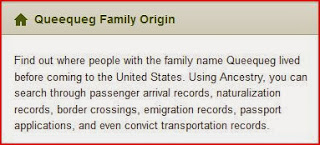
I decided to look up Queequeg just in case something returned. I guess not. It looks like the other names are largely from Great Britain, particularly England (or Ireland for Flask). This isn't too surprising since most white people in the United States (particularly Nantucket, Massachusetts) at this time were from England.
Queequeg
I decided to just do a Google Search, "What does Queequeg mean?" and see what I got. I found a blog post that has a passage I really liked in relation to my own blog post: "Queequeg, a cannibal prince whose very name seems devoid of meaning, is a strange combination of everything exotic and foreign to Ishmael." His name is "devoid of meaning." That does seem quite suitable for Queequeg's character. He has so much character yet he is one of the more difficult characters to understand. Well-played, Melville.
Conclusion
I don't know how much thought Herman Melville put into the names of his characters, but it seems to me like he put in at least some. He certainly thought about who they were and what they represented to the reader, to the other characters, and to themselves. While I'm not sure that these characters could not have been called by any other name, I do think the names, particuarly Ahab's and Ishmael's, were well chosen because of the extra religious symbolism they give to their characters. This was an interesting exercise for me to do and I'm glad that I was able to use these tools to look a little more deeply into the names of these six characters.
I decided to put Shakespeare's words to the test and look at the names of the six main characters in Moby Dick. I wanted to see if there was any extra significance to their names, or if they really were just names. I decided to look up the origins of the names, their meanings, and then the text surrounding their names in Moby Dick.
Origins
I used Google Translate to look up the origins of their names. Here is what I found:
Ahab: German
Queequeg: no response, but Spanish was guessed before I finished typing the name.
Ishmael: no response, but English and Albanian were guessed.
Stubb: Finnish
Starbuck: no response, but Italian, English, German, Lithuanian were guessed.
Flask: no response, but Portuguese and Albanian were guessed.
Then, just for kicks, I decided to see if their names would translate to a language completley different from English. Here are their names in Japanese:
Ahab: アハブ
Queequeg: would not translate
Ishmael: イシマエル
Stubb: would not translate
Starbuck: スターバック
Flask: フラスコ
The names translated back to English from Japanese name perfectly each time. When I translated the Japanese name to another language like Russian or Alabanian and then back to English, it sometimes went back to the way the name was in English (like for Ishmael), but a different translation (such as Flask to bulb).
Continued Research into Origins and Meanings
I decided to do some more research into the origin/meaning of the names and came across the site Behindthename.com. I stuck each name into the search bar and below are the screen shots of what appeared.


The only names Behindthename.com was able to find anything for was Ahab and Ishmael (both Hebrew names that English speakers name their children). Both names are biblical, which may explain why there is so much Biblical language in the book (it fits the two main characters). Starbuck had a popular culture reference, but nothing to do with Moby Dick.
In the Text
I decided to look at the text itself to see if there were any words that were commonly linked with each of these six characters. The words listed below are both those used to describe the characters, phrases near the names that I found interesting, or words that often appeared near the name at multiple points in the text.
Ahab: precise agency, inscrutable, leaped after his prey, Captain, peculiar fortunes, side-lunging strides, commanded, a queer man, grand, godly, ungodlike, above the common, a crowned king, a wicked name, King, "I am a cannon-ball."
Queequeg: Ramadan, entertaining, absurd notions, content, knew, harpoon, pagan, cannibal, tomahawk, savages, creature, civilized, alone, heathen, Christian, affectionate, ambitious, embrace, kill-e, Yojo.
"A native of Rokovoko, an island far away to the West and South. it is not down in any map; true places never are."
Ishmael: Call me, one, dear, don't be too particular, said I, muttered I, thine, thought I, I, thy, unlettered. Talks to himself a lot. Lots of bibilical language--he is the narrator.
Stubb: luck, aye, easy, pipe, mate, humorous, speechless a moment, involuntarily retreated, old man, wise, laugh, odd, peculiar, Mr., drawled, counted upon, cheered, cried, supper, Starbuck, Flask, Ahab
Starbuck: lively, friend, chief mate, courage, fortitude, Mr., murmured, paled, right-mindedness, coerced will, cooly and adroitly balancing himself, careful, prudent, humane, too good a fellow, Stubb, Flask, Ahab
"A native of Nantucket, and a Quaker by descent"
Flask: Mr., one of the wrought ones, little, curious, helped himself, presume, mate, Starbuck, Stubb, Ahab, cruel, cried, water-bearer, "Why don't ye be sensible?", startled
While these words provide more character sketches than origins or meanings of the names, I did find it interesting how one could do a mere search of each character's name and find out a surprising amount about each character before ever reading the text. Sometimes I was able to find out where certain characters were from, like Queequeg or Starbuck. It looks like Starbuck's name is a surname, not a first name like I had assumed in my original searches, same with Stubb and Flask. Let's see if that changes things.
Surnames
I went to ancestry.com to learn the meaning behind the surnames. Here are screen shots of what I found:


I decided to look up Queequeg just in case something returned. I guess not. It looks like the other names are largely from Great Britain, particularly England (or Ireland for Flask). This isn't too surprising since most white people in the United States (particularly Nantucket, Massachusetts) at this time were from England.
Queequeg
I decided to just do a Google Search, "What does Queequeg mean?" and see what I got. I found a blog post that has a passage I really liked in relation to my own blog post: "Queequeg, a cannibal prince whose very name seems devoid of meaning, is a strange combination of everything exotic and foreign to Ishmael." His name is "devoid of meaning." That does seem quite suitable for Queequeg's character. He has so much character yet he is one of the more difficult characters to understand. Well-played, Melville.
Conclusion
I don't know how much thought Herman Melville put into the names of his characters, but it seems to me like he put in at least some. He certainly thought about who they were and what they represented to the reader, to the other characters, and to themselves. While I'm not sure that these characters could not have been called by any other name, I do think the names, particuarly Ahab's and Ishmael's, were well chosen because of the extra religious symbolism they give to their characters. This was an interesting exercise for me to do and I'm glad that I was able to use these tools to look a little more deeply into the names of these six characters.
Subscribe to:
Posts (Atom)