So! I've been thinking about Brittany's project and trying to think of ways I could help out. I'm not much of a do it yourselfer, but I was wondering about some of the movements and how they impacted society. So, I hope this helps Brittany!
This is the blog I told you to look up in class: Design Mom
I also found an interesting article about the do-it-yourself movement and our modern understanding of masculinity and femininity: Mr. FixIt
Capitolism and DIY: Click here for information!!!
And I think this article is talking about the subjugation of women, which might be an interesting take on DIY, or even just a nice counterargument: Women
And this one is in support of people who are ill: Support
I hope any of this information helps. I'm not sure if any of it is in the direction that you're going for, but I also have lots of friends with really interesting pinterest boards that might be of some help. Crafts, DIY, Sewing.
Good luck on your project!!
Thursday, November 21, 2013

Monday, November 18, 2013
My Research on Fandoms (for Victoria)
In all of my research for my personal topic of youth online, I have come across a lot of material regarding fandoms and I've always thought to myself that I wish I could just link them all to Victoria, since I knew this was her subject. Regretfully, I didn't! This not only applies to Victoria, but to any of the topics in class. Just through my personal experience in researching, I've found that digital culture is like a giant spiderweb where everything somehow connects to everything. Because of this, I've come across a lot of articles for various subject.
For now though, I am going to do some altruistic research on fandoms and their benefits. I worry that Victoria has already seen all of these links, but I might as well try. Hopefully Victoria, and anyone else with similar subjects, will benefit from some of this research! I found it very clear and helpful for me to see how Kristen organized her research blog post for me and my subject, so that's how I will organize my findings here.
Scholarly Articles:
Fandoms and Media Literacy
Interactive Audiences
Female Fandoms Online
Fantasy Franchises/Fandoms
Visible Fandoms
The Death and Closing of a Fan Community
Twitter and Fandoms
Articles:
Rise and Fall of Fandoms
Selling Fan Fiction
The "Why" behind Fandoms
Happiness in Fandoms
Fandoms Being Seen
Misc:
25 Most Devoted Fan Bases
Video: Can Fandoms Change Society?
 |
| http://shaenlir.blogspot.com/2013/01/fandoms.html |
Scholarly Articles:
Fandoms and Media Literacy
Interactive Audiences
Female Fandoms Online
Fantasy Franchises/Fandoms
Visible Fandoms
The Death and Closing of a Fan Community
Twitter and Fandoms
Articles:
Rise and Fall of Fandoms
Selling Fan Fiction
The "Why" behind Fandoms
Happiness in Fandoms
Fandoms Being Seen
Misc:
25 Most Devoted Fan Bases
Video: Can Fandoms Change Society?
For Shelly's Research on Children and the Internet
 |
| sheknows.com/parenting/articles/810053/how-to-monitor-your-kids-on-the-web |
Microsoft below).
After doing just a little bit of research, it seems that children should be able to get on the internet with proper parental guidance. The internet is a tool that can be used, like most, for good or evil. But with proper guidance it can be an amazing tool for creativity, schoolwork, and scholarship. Instead of steering children away from the internet, let's guide them through it.
I hope these links help you in your research Shelly! Best of luck!
Articles
Kids on the Internet: It's a Good Thing
Family and Media: A New POLIS Report
Google and Microsoft Agree Steps to Block Abuse Images
What Are They Doing Online?
Scholarly Articles
Children, Adolescents, and the Internet: A New Field of Inquiry in Developmental Psychology
Guide and Seek
Long Term Study of Safe Internet Use of Young Children
Personality and Motivations Associated with Facebook Use
Opposition to Consider
While Their Kids Sleep, These Parents Pull of This Amazing Stunt
The Children's Internet Protection Act
Cognitive-Behavioral Approaches to Outpatient Treatment of Internet Addiction in Children and Adolescents
Why are Children Attracted to the Internet? The Role of Need Satisfaction Perceived Online and Perceived in Daily Real Life
Sunday, November 17, 2013
A Huge Whale Fanboy
A few weeks ago I posted to my facebook, twitter, and google+ account asking if anyone thought that fandom's have inherent value. I didn't get any responses via twitter, and only two each from facebook and google+. This actually really surprised me, because a lot of my friends and family are into fandoms and participate in fandom culture, but none of them seemed interested in responding to my question. Here are their replies:


Everyone who replied seemed to think that if fandoms have inherent value it is because they bring people together and form a certain community. People need to connect with other people and connecting through a common interest is an easy and fun way of doing that. I found this really interesting mixed with the fact that not many people seemed to respond to my question. If fandoms are a sense of community, then why don't people want to talk about them in a public place? And I'm not talking about something specifically devoted to fandoms (such as a pinterest, tumblr, facebook or google+ page) which can be considered a "safe place" for such things to be talked about. I'm talking about discussing intellectually the value of a digital culture phenomena. Not many people seemed to really be interested in that.
One of my friend's liked the post. I know that she is a big fan of a lot of different fandoms, but she didn't say anything. I can assume that because she liked the status she thought that fandoms have value (and since I know her personally I feel pretty safe assuming that) but I don't know why she didn't think to explain why.
As I have done my research on fandoms through curation, I've discovered that people often consider fandoms to be "crazy" (see my previous post here) and identify as "other" than the general population (often called "normal people" within a given fandom.) But why? And what does that have to do with Moby Dick?
As I have looked through Moby Dick for my facebook project, I've gained a new appreciation for how much research and study Melville went through to find out as much as he possibly could about whales. And he didn't just study the anatomy or make up a new classification system, no, he tried to find every source for every famous story ever told about whales. He looked up quotes and tied them together, from epic poems to the bible. He found everything that he could about whales so that he could write a story about them, even if the story he found had nothing to do with the novel he eventually was going to write. He then piled all of those quotations and information at the beginning of the book and titled it "Extracts." This portion of the book is easily looked over and ignored, but was deemed important enough that Dr. Burton told us that we had to read it.
Why?
I think Melville (and by extension -- Ishmael) is a huge fan of whales. He displays all of the symptoms of a fanboy. He spent a large amount of time finding whatever information he possibly could about a topic and righteously defended it when he thought people might attack the subject (exp: chapter 24 of Moby Dick). Ishmael considered himself "apart" from the landsmen, and thought of them as ignorant. And the most important detail: Melville has a lot of "unnecessary" whale content. Content that nowadays, I am convinced an editor would have had him throw out in order to be more focused upon the plot.
Moby Dick is held in such high prestigious accord that I don't know if people will feel uncomfortable considering themselves a part of a "Moby Dick Fandom." Because of the stereotypes regarding fandoms (held both within and without) it's not the most comfortable of ideas. But, I think that the study of literature is the precursor of the fandom.
In order to make sure that Moby Dick has a fandom, I searched for fanfiction on fanfiction.net. This is only a portion of the results I found:

Moby Dick has a fandom. But do they include academics? I think so. Academics may not write fanfiction about the novel, but they do write papers and papers on it. They look through the text to find tiny evidence of their theories and string it together to help others look at the story in a different way. Isn't this exactly what fandoms do? I have found many examples of theories and analytical readings within fandoms. Below is an example of this. This is not one of the very best that I've seen, but it demonstrates some of the ways fans are dissecting their shows or books in order to discover different meanings or readings of them.
 |
| It also shows how fandoms are more likely to freak out, but you can't write that into an academic paper |
Melville is a highly respected, talented author. He was also a fanboy over whales and everything to do with whaling. He was as obsessed as any fangirl today. Academics are highly focused and intelligent men and women who are doing a better accepted form of fan theory, allowing their analytical skills and education to grant them the time to obsess over something they enjoy without being judged (at least too harshly) for it.
Fandoms can be extreme and frightening, especially when someone jumps into one unprepared, but I think that the aversion and mockery of fandoms should stop. I think that people shouldn't be afraid to admit to being in a fandom, or think that if they are then they're some how weird or different from other people. Fandoms aren't actually a new concept at all, it's a really old concept that is now getting access to a more general public. I believe that the more fandoms become accepted, the better people will be at studying and learning from the media and entertainment that they consume, rather than being embarrassed about it. After all, if studying 500 year old literature still has value within the academic sphere, then why can't fandoms?
What do you think?
Ishmael and Youth Online
I've been doing a lot of research on youth being online and the effects it has been having on them. Don Tapscott's book, Grown Up Digital: How the Net Generation is Changing Your World really helped further my investigation. Now I am trying to relate this back to the story of Moby Dick.
I want to focus on Ishmael paralleling with a member of the net generation, seeking for something beyond what has been traditional and mundane. "I thought I would sail about a little and see the watery part of the world. It is a way I have of driving off the spleen, and regulating the circulation. Whenever I find myself growing grim about the mouth; whenever it is a damp, drizzly November in my soul; whenever I find myself involuntarily pausing before coffin warehouses, and bringing up the rear of every funeral of every funeral I meet… then, I account it high time to get to sea as soon as I can" (Melville).
As I reviewed this passage where Ishmael continues to express his desire to leave home and head for sea, I was reminded of a passage in Tapscott's book, Grown Up Digital. In the third chapter of the book, Tapscott dissects eight characteristics of a standard net generation brain. The very first characteristic he lists: freedom. "Our research suggests that they expect to choose where and when they work; they use technology to escape traditional office space and hours; and they integrate their home and social lives with work life. More than half of the Net Geners we surveyed online in North America say they want to be able to work in places other than an office" (Tapscott).
Ishmael and a Net Gener have a yearning for something bigger than they are.
Another characteristic of a Net Gener is scrutiny. "The Net Generation knows to be skeptical whenever they're online" (Tapscott). Ishmael is a great representative of scrutiny. Starting at the beginning of his adventures, we see how Ishmael scrutinizes everything he comes across. While he is in the Spouter Inn, he must take in and study every object he finds in his room, "Folding back the counterpane, I stooped over the bed. Though none of the most elegant, it yet stood the scrutiny tolerably well" (Melville). Beyond objects, Ishmael scrutinizes people, such as Queequeg.
These are just two of many characteristics that both a Net Gener and Ishmael share. By the end of the novel, Ishmael manages to be the sole survivor of the Pequod ship. He observed closely throughout his voyage and he gained more wisdom than he already had. I once wrote a blog discussing if it is a positive or negative thing to allow youth to be online. I didn't have a firm stance then, and while there are still some necessary precautions, I think Ishmael represents why it is good to learn and be online at an early age. You gain so much wisdom through a click of the button. There are dangers, but you learn to avoid them and handle them.
I want to focus on Ishmael paralleling with a member of the net generation, seeking for something beyond what has been traditional and mundane. "I thought I would sail about a little and see the watery part of the world. It is a way I have of driving off the spleen, and regulating the circulation. Whenever I find myself growing grim about the mouth; whenever it is a damp, drizzly November in my soul; whenever I find myself involuntarily pausing before coffin warehouses, and bringing up the rear of every funeral of every funeral I meet… then, I account it high time to get to sea as soon as I can" (Melville).
As I reviewed this passage where Ishmael continues to express his desire to leave home and head for sea, I was reminded of a passage in Tapscott's book, Grown Up Digital. In the third chapter of the book, Tapscott dissects eight characteristics of a standard net generation brain. The very first characteristic he lists: freedom. "Our research suggests that they expect to choose where and when they work; they use technology to escape traditional office space and hours; and they integrate their home and social lives with work life. More than half of the Net Geners we surveyed online in North America say they want to be able to work in places other than an office" (Tapscott).
Ishmael and a Net Gener have a yearning for something bigger than they are.
Another characteristic of a Net Gener is scrutiny. "The Net Generation knows to be skeptical whenever they're online" (Tapscott). Ishmael is a great representative of scrutiny. Starting at the beginning of his adventures, we see how Ishmael scrutinizes everything he comes across. While he is in the Spouter Inn, he must take in and study every object he finds in his room, "Folding back the counterpane, I stooped over the bed. Though none of the most elegant, it yet stood the scrutiny tolerably well" (Melville). Beyond objects, Ishmael scrutinizes people, such as Queequeg.
These are just two of many characteristics that both a Net Gener and Ishmael share. By the end of the novel, Ishmael manages to be the sole survivor of the Pequod ship. He observed closely throughout his voyage and he gained more wisdom than he already had. I once wrote a blog discussing if it is a positive or negative thing to allow youth to be online. I didn't have a firm stance then, and while there are still some necessary precautions, I think Ishmael represents why it is good to learn and be online at an early age. You gain so much wisdom through a click of the button. There are dangers, but you learn to avoid them and handle them.
Saturday, November 16, 2013
Ahab the Maker
Through my research of the Maker Movement, I have been inspired time and time again as I find real people engaged in real projects through digital means, which in turn grows into something important and passionate - even something personal.
Makers: The New Industrial Revolution revels in the emergence of the small business owner. The way that Anderson claims that these small business owners are able to thrive is through the importance of using the available tools. He claims that those who use these open-sourced tools are "often the best source of new ideas and innovation" (Anderson, 115).
Okay, so what does this mean?
It means that when we remix (see my earlier blog post) and create our own version of something to synthesize a new product, we're taking ideas that have all ready gone around the block and we're personalizing them. And that's where the magic happens. That's the beauty of DIY digital edition.
In taking this concept to the stormy seas of Ahab's quest, I see Ahab as one of these small business owners. Ahab's familiarity with the whaling industry has given him the tools to create his personalized whaling experience: "Ahab's above the common; Ahab's been in colleges, as well as 'mong the cannibals; been used to deeper wonder than the waves" (Melville, 71).
He has the boat, the crew, the social network, the supplies, the experience. And when all these come together, he realizes that he can use these tools for his own personal use - that use being his personal, blood-thirsty quest to conquer Moby Dick.
Ahab's resources make all the difference. Without all the available resources, he would never have gained the reputation and ability to lead his crew into such an adventure. Like Ahab, we too have the digital resources to take our amateur skills and refine them as we gain experience and information in our desired quest. In a sense, it's even easier to become a professional than it was for Ahab.
So you may be thinking, "I don't want to be a businessman like Ahab... he led himself and all but one of his crew members into the jaws of death."
Well fortunately for Makers and entrepreneurs everywhere, there is less on the line when personalizing our mission or product. Anderson says, "The step from making one to making thousands is simply a matter of how much you want to pay (or put on your credit card)" (26). As I've summarized this concept before in Anderson's book, the digital age allows Makers to create compatible digital designs that can be manufactured in small batches to accommodate our budget and start-up plan. Ahab, on the other hand, decided to go all out despite the various reality checks that he averted. Although Ahab was warned, he went past the mark and failed miserably. With less at stake for us with small batches, there's less to risk.
Are you feeling risky? It's time to start personalizing, exploring, and producing.
Makers: The New Industrial Revolution revels in the emergence of the small business owner. The way that Anderson claims that these small business owners are able to thrive is through the importance of using the available tools. He claims that those who use these open-sourced tools are "often the best source of new ideas and innovation" (Anderson, 115).
Okay, so what does this mean?
It means that when we remix (see my earlier blog post) and create our own version of something to synthesize a new product, we're taking ideas that have all ready gone around the block and we're personalizing them. And that's where the magic happens. That's the beauty of DIY digital edition.
In taking this concept to the stormy seas of Ahab's quest, I see Ahab as one of these small business owners. Ahab's familiarity with the whaling industry has given him the tools to create his personalized whaling experience: "Ahab's above the common; Ahab's been in colleges, as well as 'mong the cannibals; been used to deeper wonder than the waves" (Melville, 71).
He has the boat, the crew, the social network, the supplies, the experience. And when all these come together, he realizes that he can use these tools for his own personal use - that use being his personal, blood-thirsty quest to conquer Moby Dick.
Ahab's resources make all the difference. Without all the available resources, he would never have gained the reputation and ability to lead his crew into such an adventure. Like Ahab, we too have the digital resources to take our amateur skills and refine them as we gain experience and information in our desired quest. In a sense, it's even easier to become a professional than it was for Ahab.
So you may be thinking, "I don't want to be a businessman like Ahab... he led himself and all but one of his crew members into the jaws of death."
 |
| Despite the genre of political cartoon, I actually found a picture linking Ahab and Business! |
Well fortunately for Makers and entrepreneurs everywhere, there is less on the line when personalizing our mission or product. Anderson says, "The step from making one to making thousands is simply a matter of how much you want to pay (or put on your credit card)" (26). As I've summarized this concept before in Anderson's book, the digital age allows Makers to create compatible digital designs that can be manufactured in small batches to accommodate our budget and start-up plan. Ahab, on the other hand, decided to go all out despite the various reality checks that he averted. Although Ahab was warned, he went past the mark and failed miserably. With less at stake for us with small batches, there's less to risk.
Are you feeling risky? It's time to start personalizing, exploring, and producing.
Friday, November 15, 2013
Name, Identity, and Meaning: How the name "ERM" or "Early Returned Missionary" Ought to Be Eliminated
In my last post, I talked about the names of the six main characters in Moby Dick and did a bit of amateur research on the origins and meanings behind those names. I know that some authors name their characters specific names because the name will add deeper meaning to the character and to the story. I wanted to see if this was the case with Herman Melville. What I found was that for the most part, the names in Moby Dick could be interchangeable with other names, but two at least seem to have been deliberately given their names (Ahab and Ishmael). We see the biblical references surrouding those names pretty consistently throughout the novel. Yet even those characters, could have been given a different name (say, Solomon instead of Ahab, or Jacob instead of Ishmael. The names would have served the same purposes and meanings).
I wanted to do more research into names and the meaning they hold for us. I asked my friends on Facebook to answer a series of questions. I originally posted one of them also on Google + and Twitter, but only one person replied to my Google + post and no one replied on Twitter (sad!), but I got a lot of replies on Facebook so I decided to just stick with them. I posted the questions about once every hour, and some people really started getting into them. It was fun for me to receive the replies. Now, I'm going to be a good English major and analyze those answers and draw some conclusions from them.
Let's start with the least intimidating of the questions: Why were you named ____? (Were you named after someone? Did your parents just like the name?) What does your name mean? If the main character of a book was created with you in mind, would you want the character to have your name or another name?
Here were the answers:


The responses vary from serious to light-hearted. If everyone was honest about writing down their first-instinct response then the general pictures that comes to mind is of a young LDS male, desirable for marriage, who just did something amazing, although he might not have a clue what he's going to do next and he's probably going to be awkward until he settles back in to normal life.


I wanted to do more research into names and the meaning they hold for us. I asked my friends on Facebook to answer a series of questions. I originally posted one of them also on Google + and Twitter, but only one person replied to my Google + post and no one replied on Twitter (sad!), but I got a lot of replies on Facebook so I decided to just stick with them. I posted the questions about once every hour, and some people really started getting into them. It was fun for me to receive the replies. Now, I'm going to be a good English major and analyze those answers and draw some conclusions from them.
Let's start with the least intimidating of the questions: Why were you named ____? (Were you named after someone? Did your parents just like the name?) What does your name mean? If the main character of a book was created with you in mind, would you want the character to have your name or another name?
Here were the answers:


As I suspected, everyone knew why they were named what they were named and several knew what their names meant. And most everyone that answered the third question said that they would be fine with their name being used as the main character in a book, which surprised me as I thought more people would want their identities kept secret, but it turns out most would be excited to have the main character in a book named after them. Another person identified well with a famous book character. This to me showed that people identify strongly with their names; in other words, names are a strong part of a person's identity. If someone doesn't like their name, they generally go through some lengths to change it, right? They do not want that name as part of their identity. (Yes, I know I completely abused the singular vs. plural rules of grammar, but no one really cares, right?).
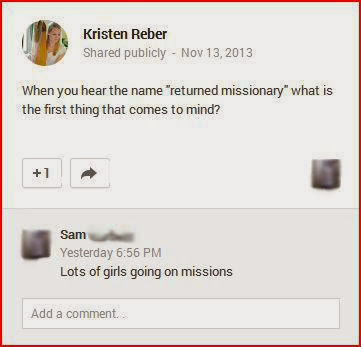
Okay, next I decided to start asking about something closer to my heart. I wanted people's instinctual reactions to the names (or titles) "returned missionary" or "early returned missionary." Here are the replies for "returned missionary."


I'd say that's generally the first thing that comes to my mind too. Again, the answers varied, but those were the general agreements.
Here are the responses for "early returned missionary":


The answers to this questions were much more serious. Usually people responded with some kind of reason for why the missionary returned home early, and it's never a happy reason. Most also show a genuine concern for the person's well-being. Some said that they usually think, "None of my business," which some could interpret as "I want nothing to do with this," but I think it was meant more as, "It's not my place to judge this person." Others alluded to dying or not being able to "hack it." One person said, "Relief."
None of these responses are wrong or bad. They are all accurate in one way or another. Most are kind. But they are markedly different from the spiritual/light-hearted responses the name "returned missionary" received. "Early returned missionary" is different from "returned missionary."
Do you see where I might be going with this? Probably. Humor me though while I explain/expound.
When I came home early from my mission (physical illness was the reason), I was fortunate enough to have a good support group around me, and for the most part I did not feel harshly judged for coming home early. Yet while I did not exactly feel judged, I did feel "marked." Everyone in my ward
knew I had come home early. My friends knew. My family knew. People asked me if I was going to go back to the field. They asked when. When I chose to stay home, people asked me if I had forced myself to go on a mission when maybe I wasn't supposed to. I didn't have answers to these questions. I just wanted them to stop. I had served a mission!! It was short, but I had served one! But I hadn't served it for the expected amount of time, and therefore I had failed. I had done something wrong and I hadn't repented well enough for it; I hadn't had enough faith; because if I had repented well enough or had enough faith I would have been healed and I would still be on a mission. God would still be able to use me.
But no, I was an early returned missionary. An ERM. I cringed every time somebody called me either name. It hurt. "That title will haunt me forever," I thought.
I asked my friends one last question. Would
you say that "returned missionary" is a name one earns or is it a name
that should be given to anyone who comes home from a mission?


It sounds like the general consensus was, "If you served a mission and are now home, no matter the length of time in the field, and no matter your thoughts and intentions while serving a mission, you are a returned missionary. Whether or not you served honorably is another thing."
I was so surprised by these responses. I thought most people would say that, "You are a returned missionary if you served the 18-24 months or if you came home early but it wasn't your fault." But no, almost everyone said that if you serve a mission and come back, you are a returned missionary.
So where did Early Returned Missionary/ERM come from? My guess is that it started on a forum somewhere for those trying to help missionaries who return home early. It sounds like it was a easy way to distinguish online between someone who came home early and someone who served the amount of time. "Returned missionary" is still in the title, but it is marked with "Early."
Some of my friends think that we should just get rid of the terms "returned missionary" and "RM" altogether. They think it encourages us to label each other, or in other words to judge each other, and in a church that emphasizes Christlike behavior those labels ought to be done away with.
They might be right. But even if they are, I think that the names "returned missionary" and "RM" are going to stick around a little longer. As members of the church, we've been encouraged to stop calling ourselves "Mormon," but that name is dying hard. Why? I think its become part of our identity for so long.
What I personally would like to see happen is the death of the name/term/title/(whatever you want to call it) "Early returned missionary," or "ERM." Especially "ERM." I recognize that it is not meant to hurt those who did return early, (or if it is, shame on whoever uses it that way!), but it does. It hurts a lot. It's not a title of honor. It's not something I want following me around the rest of my life. Even if I returned home early because I made a mistake and was caught, I would not deserve to be called an ERM the rest of my life. It's like The Scarlet Letter that Hester Prynne has to wear the rest of her life. She sinned and she needed to be held accountable for that, but being marked for the rest of her life was unfair, especially when so many others were committing sins (even the same sin!) all around her.
On my website, www.earlyhomecoming.com, I avoid the terms "early returned missionary" and "ERM." I recognize that many, many people are using these terms for good as they study the effects of returning home early from a mission. It's a non-wordy way to say, "a missionary who returned home early." But it's unfair, and I would hate to see it become a popular term used in the church. So please, let's drop it. And maybe, let's drop "returned missionary" too, and just leave it at "I served a mission."
There is more that I can go into about this. I could get all doctrinal about missionaries and missionary work, but I'm not going to, at least not in this blog post. Maybe in a future one. For now, I'm just going to ask that we remember the importance of names, how they serve as our identities, and how no one wants anything to tarnish their name, not even a well-meant title. If we don't like something, we get rid of it. We change our names. But if we're in a society that won't let us forget our names, our identites, we either become depressed or indifferent, or we escape. According to a study done by the University of Utah, "34 percent of those who returned early went through a period of inactivity in the church. One third of those never returned to activity."
This is a problem. I don't know how many of those 34% were called "ERM's" or "Early Returned Missionary," but I'm positive that they felt marked in some way.
So here's my call to action: Let's get rid of the term "ERM" or "Early Returned Missionary" from our vocabulary, from our culture, as much as possible. I recognize that the names will likely still be used in some circumstances for good, like as in forums, but as much as possible let's just get rid of them. Let's stop calling each other undesirable names. Let's not be like Captain Ahab's mother who named him after a wicked king because of a "foolish, ignorant whim." Let's not wrong each other because we have hard times. Let's just help each other. Let's change our culture.
Subscribe to:
Posts (Atom)